
FDM vs Resin 3D Printing: Which Technology is Best for Your Projects?
3D printing has revolutionized how we create, from hobbyists crafting tabletop miniatures to engineers prototyping functional parts. In 2025, two technologies dominate the market: FDM (Fused Deposition Modeling) and Resin (SLA/DLP). But which is best for your projects? This guide breaks down the differences between FDM and resin 3D printing, helping you choose the right technology for your needs. Whether you’re a beginner or a seasoned maker, we’ll explore costs, quality, safety, and more to ensure your 3D printing journey is a success. Let’s get started!
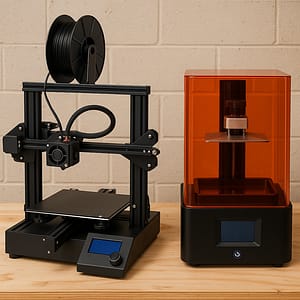
FDM and resin 3D printers offer unique benefits—find out which suits your projects!
What Is FDM 3D Printing?
FDM, or Fused Deposition Modeling, is the most common 3D printing technology for beginners and hobbyists. It works by melting a plastic filament (like PLA or PETG) and extruding it layer by layer to build an object. Popular printers like the Creality Ender-3 V3 SE and Bambu Lab A1, available on our website, use FDM technology.
Key Features of FDM:
- Affordable: Printers start at $150–$400, with filaments like PLA costing $20–$30 per kg.
- Versatile: Prints larger objects (e.g., 220 x 220 x 250 mm build volume on the Anycubic Kobra 2 Neo).
- Beginner-Friendly: Easy to set up and use, with minimal safety concerns.
- Material Options: Supports PLA, PETG, TPU, and ABS for various applications.
What Is Resin 3D Printing?
Resin 3D printing, often using SLA (Stereolithography) or DLP (Digital Light Processing), cures liquid resin with UV light to form highly detailed models. Printers like the Elegoo Mars 4, featured on our website, are popular for resin printing.
Key Features of Resin:
- High Detail: Achieves fine details (down to 0.02 mm layer height), perfect for miniatures and jewelry.
- Smooth Finish: Produces polished surfaces without visible layer lines.
- Compact Build Volume: Smaller print areas (e.g., 153 x 77 x 175 mm on the Elegoo Mars 4).
- Complex Process: Requires post-processing (washing, curing) and safety precautions.
FDM vs Resin: A Detailed Comparison
Let’s dive into the key differences between FDM and resin 3D printing to help you decide which technology fits your projects.
Comparison Table: FDM vs Resin 3D Printing
| Feature | FDM | Resin |
|---|---|---|
| Cost | Printers: $150–$600 Filament: $20–$30/kg |
Printers: $200–$500 Resin: $30–$60/liter |
| Print Quality | Good (0.1–0.2 mm layer height), visible layers | Excellent (0.02–0.05 mm), smooth finish |
| Build Volume | Larger (e.g., 256 x 256 x 256 mm on Bambu Lab A1) | Smaller (e.g., 153 x 77 x 175 mm on Elegoo Mars 4) |
| Ease of Use | Beginner-friendly, minimal setup | More complex, requires post-processing |
| Safety | Safe with basic precautions (hot nozzle) | Requires ventilation, gloves, masks (resin is toxic) |
| Speed | Faster for large prints (200–500 mm/s on modern printers) | Slower, layer-by-layer curing |
| Applications | Functional parts, prototypes, decor | Miniatures, jewelry, detailed models |
Cost Breakdown: FDM vs Resin
FDM: FDM printers are more affordable upfront. Entry-level models like the Creality Ender-3 V3 SE ($199) are budget-friendly, and filament costs are low. A 1 kg spool of PLA lasts for dozens of small prints, making FDM economical for frequent use.
Resin: Resin printers, like the Elegoo Mars 4 ($299), have a higher running cost. Resin is pricier ($30–$60 per liter), and you’ll need additional supplies like isopropyl alcohol, gloves, and a curing station, adding $50–$100 to startup costs.
Winner: FDM wins for budget-conscious beginners, but resin may be worth the investment for detailed projects.
Print Quality and Detail
FDM: FDM printers produce good quality prints with layer heights of 0.1–0.2 mm. However, layer lines are often visible, requiring sanding or post-processing for a smooth finish. They’re great for functional parts or larger models.
Resin: Resin printers excel in detail, with layer heights as low as 0.02 mm. They’re ideal for intricate designs like tabletop miniatures or jewelry, offering a polished, professional look right off the printer.
Winner: Resin for high-detail projects; FDM for practical, larger prints.
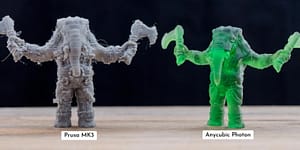
Resin prints (right) offer smoother finishes compared to FDM prints (left).
Ease of Use and Setup
FDM: FDM printers are straightforward. Models like the Bambu Lab A1 from our website come pre-assembled with auto bed leveling, making setup a breeze. Printing with PLA is simple, with minimal post